Recipes, cookbooks and retrievers
Ce contenu n’est pas encore disponible dans votre langue.
A recipe describes everything one application needs to run in a zone — images, charts, models, files — pinned to exact digests, so one signature attests the whole delivery. This page explains the concepts as you meet them in Tobby. The format itself is an open specification, published separately under Apache-2.0 at tobby-fetch.github.io/recipe-spec: everything normative — grammar, JSON Schemas, validation rules — lives there, and this page links to it rather than restating it.
The vocabulary
Section titled “The vocabulary”The metaphor is a kitchen, and it is load-bearing: each word names one precise object.
| Term | What it is |
|---|---|
| Recipe | A YAML document listing the ingredients of one application, each pinned by version and digest. |
| Ingredient | One OCI artifact a recipe references: a container image, a Helm chart, a generic OCI artifact, or a file set. |
| Cookbook | An OCI repository namespace where recipes are published as ordinary OCI artifacts. The cookbook of a zone is the authoritative catalog of software approved for that zone. |
| Retriever | A YAML document listing the recipes (and version constraints) one zone wants. It is the desired state of that zone. |
There is no dedicated server behind any of this. A cookbook is a plain OCI registry; a recipe is an ordinary OCI artifact any tool can push, pull, and sign. That choice is what lets recipes cross zones with the same tools as the content they describe — signatures included. The normative definitions are in the specification’s terminology and cookbook sections.
Recipes are Kubernetes-style manifests (apiVersion: recipe.tobby.dev/v1alpha1,
kind: Recipe), deliberately familiar to anyone who operates a cluster —
and deliberately strict: a misspelled field is rejected, never silently
ignored, because a typo in digest: must not weaken pinning
(strict validation).
Draft and cooked
Section titled “Draft and cooked”A recipe exists in exactly one of two states, and the state is not a field — it is determined by where the document lives and what it contains:
- A draft is a recipe under construction: it lives in your workspace or
git, version constraints are allowed (
~0.16.1,26.x), digests are optional. It is freely editable and diff-reviewed like any other file. - A cooked recipe is published in a cookbook: every ingredient carries an exact tag and a digest, and the artifact is immutable and signed. Fetching its ingredients at their recorded digests yields bit-identical content anywhere, forever — or fails verifiably.
Cooking is the act in between: resolving every constraint to an exact
tag, recording every digest, and publishing the result. A qualification
pipeline typically cooks a recipe after its checks pass. A cooked recipe is
never edited: any change — even one digest — requires a new
metadata.version. The full rules are in the specification’s
draft and cooked
section.
The lifecycle in a Tobby context
Section titled “The lifecycle in a Tobby context”End to end, a recipe passes through five hands:
- An author writes a draft — usually starting from an existing recipe
or from the annotated examples,
and validating it with the spec’s
recipe lintCLI. - Someone cooks and publishes it to the production cookbook — with
tobby recipe push, from the interface, or with generic OCI tooling — then signs the published digest with cosign. Tobby never holds a private key and signs nothing. - A retriever declares what a zone wants. It lists recipe names with
exact versions or constraints, resolved against the cookbook. A Tobby
instance reads its retriever from a file, an
https://URL, or an OCI artifact — see Zone retriever and cascade. - Tobby synchronizes. On each cycle it re-resolves every retriever entry, verifies each recipe’s signature against the destination’s configured trust roots, and transfers the recipe with all its ingredients — bit-exact, digests and upstream signatures intact. The recipe artifact itself lands in the zone’s cookbook, so the zone stays self-describing and auditable offline.
- Clients consume the content from the zone — Connect your clients.
For a one-shot need — a single image, once — a recipe is overkill; see Import one-off content and what that choice means for provenance.
Choosing an ingredient kind
Section titled “Choosing an ingredient kind”Four kinds cover everything a zone consumes. The choice is usually obvious; the pitfalls are not.
ContainerImage
Section titled “ContainerImage”A runnable image, possibly multi-platform. The digest pins the index
(the multi-platform manifest list), not one platform’s manifest. The
optional platforms: list names what the destination must have — naming
only what your zone runs keeps transfers and media small, while the pinned
index stays intact and verifiable. A label is os/arch[/variant], and the
variant is optional: linux/arm64 selects the arm64 image whatever
variant the registry gives it — which matters, because official images
label theirs linux/arm64/v8. Name a variant and it binds: linux/arm/v7
does not accept a v6 image, and a platform the index simply does not carry
fails the ingredient rather than being silently dropped. Spec:
§7.1.
HelmChart
Section titled “HelmChart”A chart stored as an OCI artifact (Helm ≥ 3.8 native format). Two things trip up every new author:
- A chart never implies its images. The format refuses to evaluate
templates and values: every image the chart will need must be listed
explicitly as a
ContainerImageingredient, so the transfer stays reviewable. Finding that list is the genuinely hard part of authoring — the examples walkthrough is dedicated to the four ways an image escapeshelm template. - Legacy
index.yamlrepositories are out of scope. A chart published only to a classic HTTP repository must be republished into an OCI registry you control before it can be an ingredient at all. The archive is not rewritten — the bytes, and any upstream signature, survive the move.
Leave vendorDependencies at its default (false) unless you have read
§7.2:
vendoring rewrites the chart archive, so the recorded digest is no longer
the upstream one and upstream chart signatures no longer apply.
OCIArtifact
Section titled “OCIArtifact”Everything else that lives in an OCI registry: AI models and weights,
vulnerability database bundles, SBOM collections, WASM modules, policy
bundles. The optional artifactType field is a guard: if set, the fetched
artifact’s type must match, which catches tag-reuse mistakes and repository
confusion. Spec:
§7.3.
FileSet
Section titled “FileSet”Arbitrary files — configuration bundles, offline documentation, scripts, certificates — packaged as a standard OCI image. That packaging gives two consumption modes for free: mount it read-only in Kubernetes via image volumes, pinned by digest with no drift, or extract it to disk under the spec’s safety rules. The spec site has a hands-on guide, Packaging a FileSet, for building one with a deterministic digest. A FileSet is also how a zone serves an OS package repository — see Connect your clients.
One more habit worth forming: fast-moving data does not belong in a slow recipe. A vulnerability database re-published several times a week should not be pinned beside a registry you upgrade twice a year — give it its own recipe, on its own cadence.
Version constraints, and what actually moves
Section titled “Version constraints, and what actually moves”An ingredient’s version — and a retriever entry’s — is either an exact
tag or a constraint: ~0.16.1 (patch-level), ^0.158.0 (compatible),
26.x (series), comparisons and conjunctions. The complete grammar,
including semantics that differ from common libraries, is normative in
§9.
Three behaviors matter operationally:
- Constraints are re-resolved against the cookbook at each synchronization: publishing a patch release is how it reaches every zone — no retriever file to edit.
- The highest matching version wins; if nothing matches, that entry fails and says so. There is no silent fallback, and one unresolvable recipe never blocks the others.
- In a cooked recipe, constraints are gone: exact tags and digests only. Resolution is an authoring-time and retriever-time concept.
Transfers are then differential, decided digest by digest. For each item Tobby compares what the recipe pins against what the destination holds and classifies it new (absent, will be transferred), outdated (the tag exists but points at another digest, will be updated), or up-to-date (already this exact digest, zero bytes moved). Re-running a synchronization that has nothing to do moves nothing — a property the acceptance scenarios check on real registries.
Recipes in the interface
Section titled “Recipes in the interface”Recipes are first-class in the Tobby interface, with the same data available through the API:
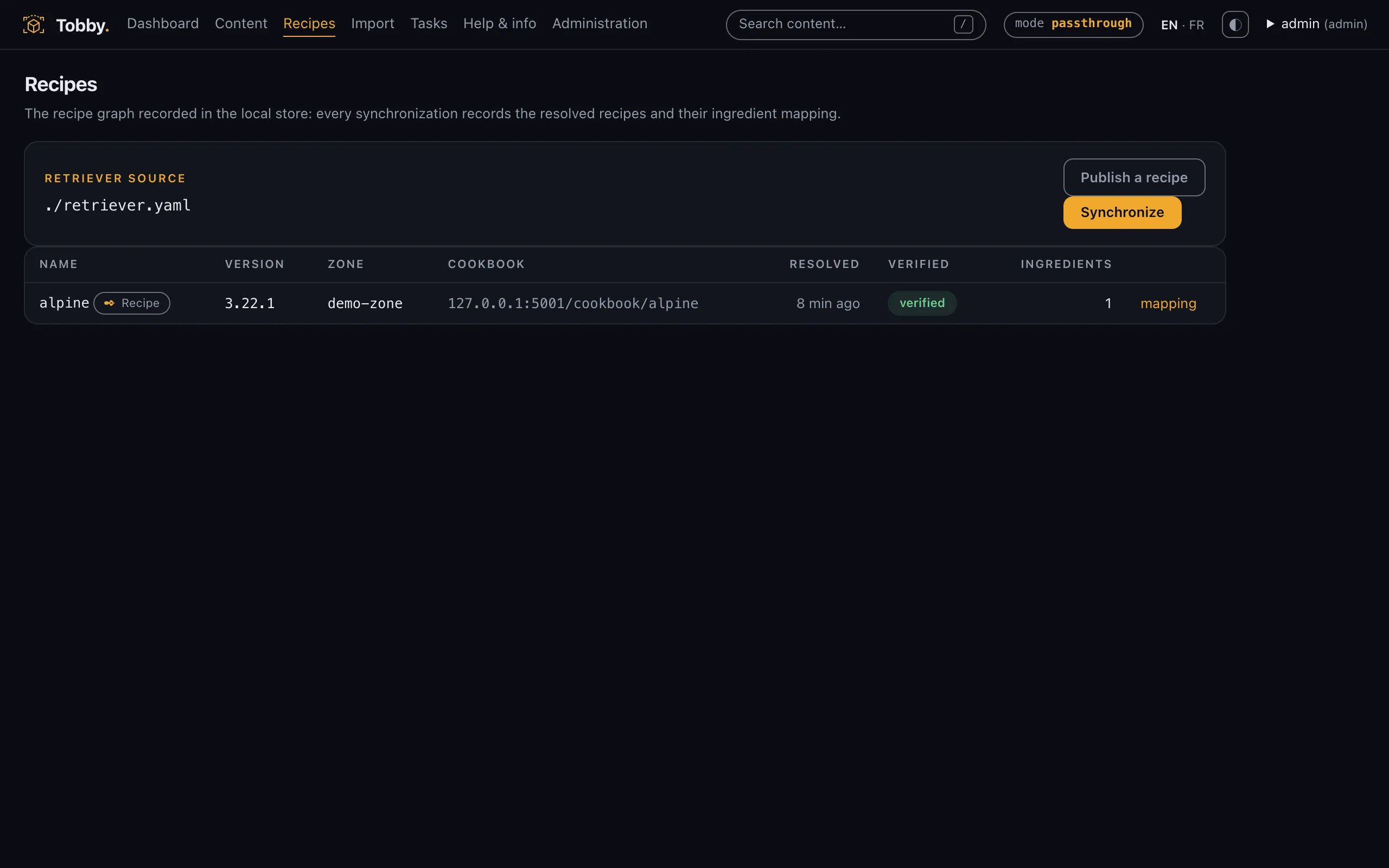
- The recipe list (Recipes) shows every recipe the instance has resolved, its version, when it was resolved, and its verification state — a recipe admitted unsigned under a declared trust scope says so explicitly, never silently.
- The per-recipe mapping lists every ingredient of each recorded version: its kind, the local relocated repository it landed in (linked, so you can walk to the content this instance actually holds), its tag, and its pinned digest — each copiable with one click.
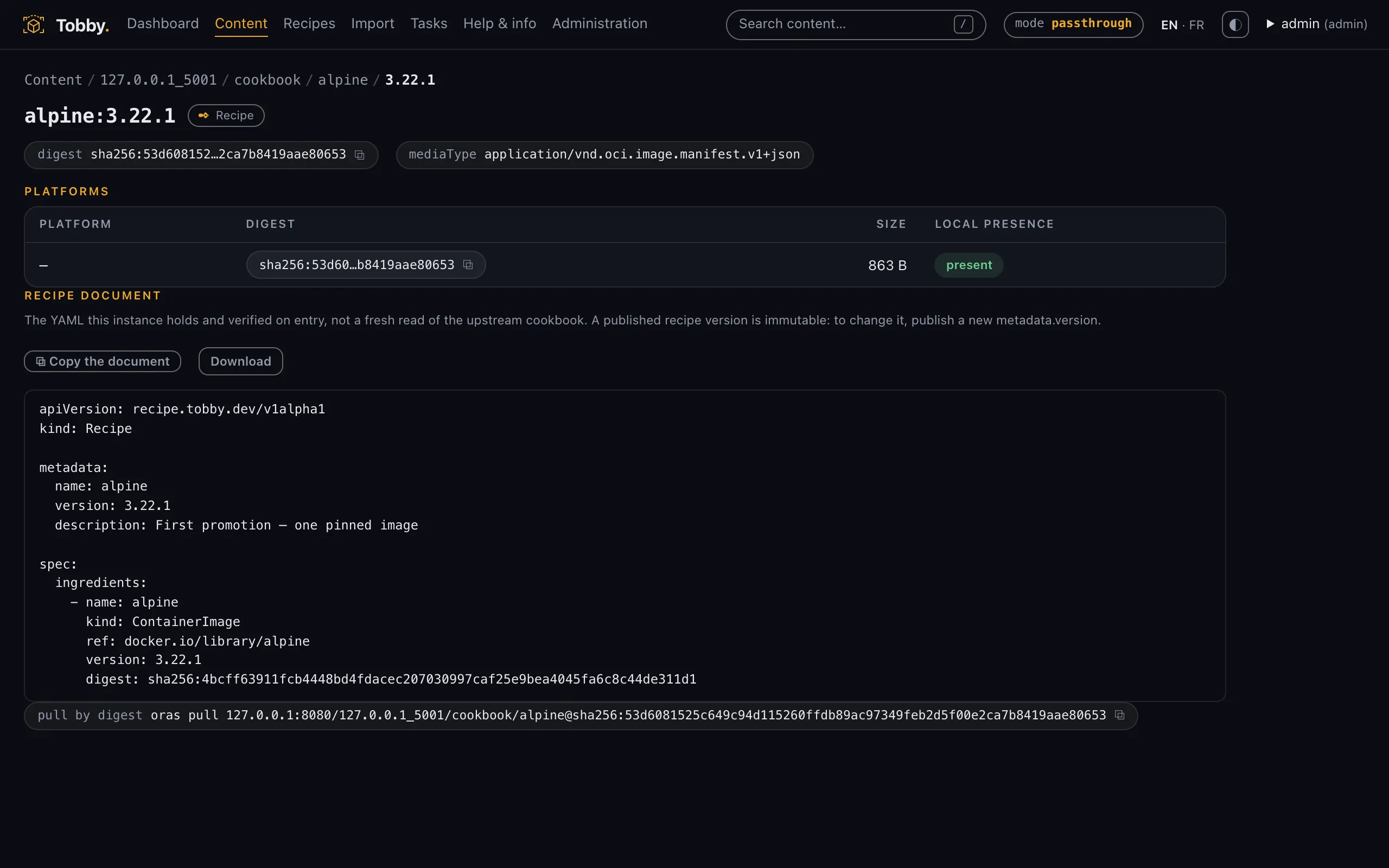
- The recipe document itself is shown on the content page of the published artifact: the exact YAML this instance holds and verified on entry — not a fresh read of the upstream cookbook — together with its digest, so the distinction stays checkable. You can copy it or download it as a file. A cooked recipe being immutable, this is deliberately a download and not an editor: it is the natural starting point for authoring the next version.
Where to go next
Section titled “Where to go next”- Write, publish and sign a recipe — the authoring walkthrough, from a minimal document to a signed publication.
- Zone retriever and cascade — how an instance consumes recipes, and how zones chain without modifying them.
- Signatures, trust roots and allowlist — how verification is configured on the consuming side.