One-off imports
Not everything deserves a recipe. A base image to try, a chart you are evaluating, one artifact a developer asked for today — Tobby imports a single OCI artifact of any media type by reference, outside any recipe run and without a container runtime on the instance (FR-023). It landed in milestone 2 and has been part of every release since.
From the interface
Section titled “From the interface”The Import screen (/import, operator role) is a two-step,
inspect-before-import flow:
- Inspect. Paste a reference —
docker.io/library/nginx:1.29,ghcr.io/org/chart:2.0.1— and the instance contacts the registry through the same shared transport as everything else (proxy, private CAs, credentials file, allowlist). One inspection is bounded byimport.inspectTimeout(default 20s); a deadline hit answers with the dedicatedTBY-REG-004code, distinct from “unreachable”. - Select and import. For a multi-platform image, each platform is a row with its digest and size, and a per-row status telling you whether the store already holds it. The button states what it will do — “Import (2 platforms, ~180 MB)” — before you press it.
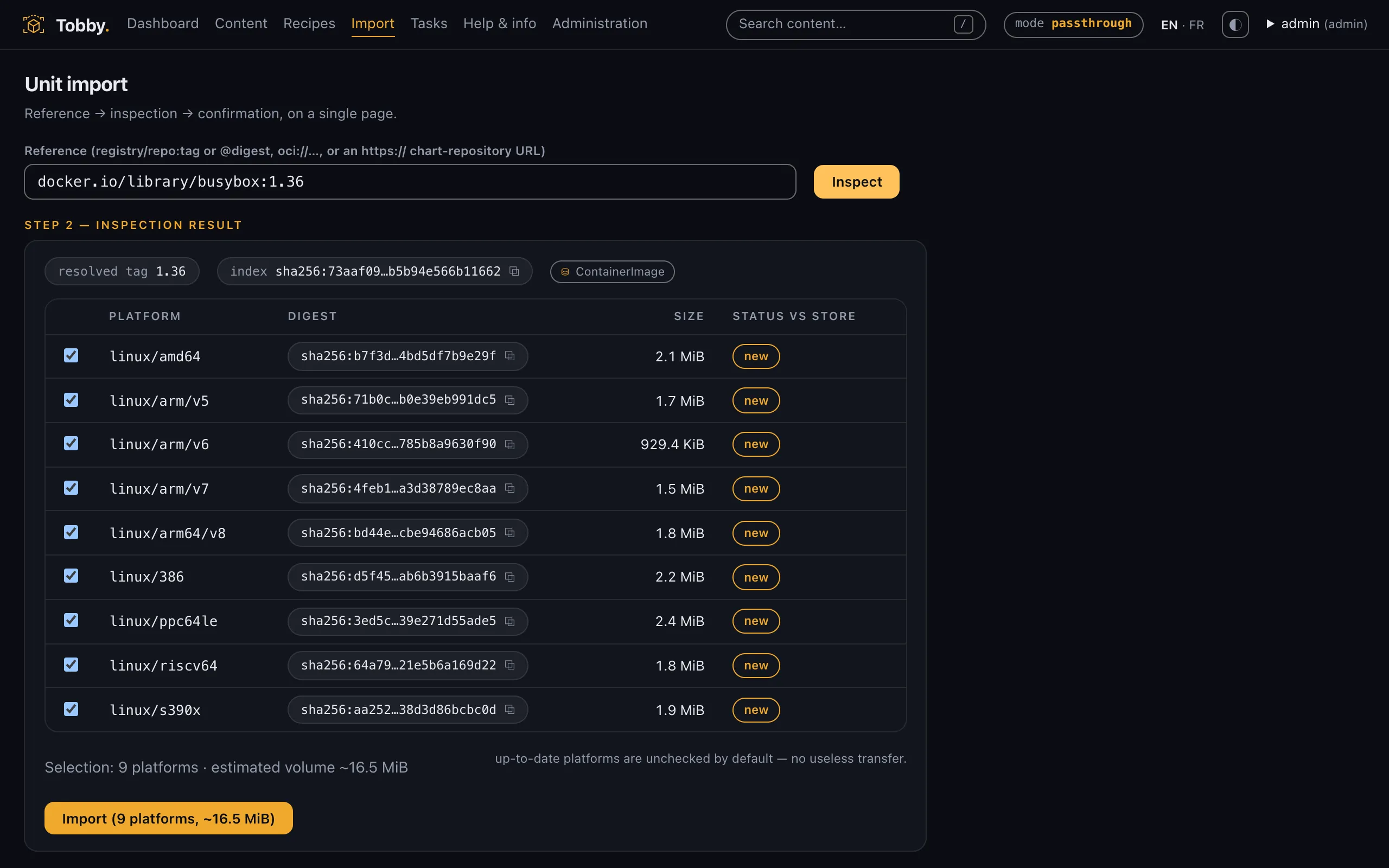
The screen is addressable: /import?ref=… pre-fills the form and
triggers the inspection on load, which is also how “retry” on a failed
import task and deep links from a manifest detail work. The POST never
trusts what the browser displayed: the server re-inspects and pins the
digests the registry serves at import time (FR-026).
From the API
Section titled “From the API”The UI is a strict mirror of the API (FR-061):
# Inspect: platforms, digests, sizes, local statuscurl -su "$USER:$PASS" \  "https://tobby.zone.example/api/v1/import/inspect?ref=docker.io/library/nginx:1.29"
# Import (operator role): returns the tracked task. Platforms are named# with the digest the inspection reported — the pin travels with the request.curl -su "$USER:$PASS" -X POST \  -H 'Content-Type: application/json' \  -d '{"reference":"docker.io/library/nginx:1.29",       "platforms":[{"name":"linux/amd64","digest":"sha256:…"}]}' \  "https://tobby.zone.example/api/v1/import"
The import runs as a tracked task — progress, per-item outcome, and downloadable log, like any synchronization (see operate). The result is pullable from the embedded registry by tag and digest, under the same relocated path a recipe would have used.
Incremental by digest
Section titled “Incremental by digest”Imports are differential, at two grains. Blobs and manifests already in
the store are never re-fetched (FR-028) — re-importing a moved tag
transfers only what actually changed. And the inspection reports
per-platform status against the store, so importing linux/arm64 of an
image whose linux/amd64 you already hold moves only the arm64 layers.
When everything is already up to date, the screen says so and gives you
the pull command instead of a button that would do nothing.
When to prefer a recipe
Section titled “When to prefer a recipe”A one-off import answers “get me this, now”. A recipe answers “keep the zone at this level” — and everything in the continuous promotion loop keys off recipes, not imports:
| One-off import | Recipe | |
|---|---|---|
| Reconciled at every cycle | no — imported once | yes |
Version constraints (~, ^, 12.x) |
no — one reference | yes |
| Pushed to the destination registry | no — store only | yes |
| Listed in the zone’s cookbook | no | yes (FR-034) |
| Signature required by default | no — see below | yes (FR-033) |
If the same reference keeps coming back through the import screen, that is a recipe asking to be written — write and publish one.
What a one-off import means for provenance
Section titled “What a one-off import means for provenance”Be clear-eyed about what you are attesting. A recipe arrives signed, and its signature — verified against your trust roots — covers the exact digests of every ingredient: someone accountable stated this content, at these digests, belongs in this zone. A one-off import carries no such statement. What you get is integrity, not endorsement: digests are pinned at inspection and verified end to end, the registry allowlist still applies (FR-030), and the action is attributed to the operator who clicked it in the audit trail (FR-094). Nobody signed the choice.
Tobby keeps the two provenances distinct in its records. Unit-imported
content does not participate in promotion, and it is the only content an
administrator can remove repository by repository — from the repository
page or with DELETE /api/v1/content/{repo} — with the removal audited
(FR-044); recipe-managed content shows the action disabled, naming its
managing recipe. In mirror mode, unit imports are excluded from the
default prune, which touches recipe-managed content only (FR-045). The
full model is content trust.
Last stop of the section: operating in the long run.