Zone Retriever and cascade
A zone is driven by one document: its Retriever. It lists, by name
and version constraint, the recipes the zone should hold, and names the
cookbook to resolve them from. The instance re-reads it at every
synchronization; changing what a zone contains means changing this
document — or publishing a new recipe version that an existing
constraint already covers. The document format is normative on the
recipe-spec site: see the
Retriever specification
(the Retriever kind, recipe.tobby.dev/v1alpha1). A complete
commented example ships in the repository as
examples/retriever.yaml.
Three sources
Section titled “Three sources”retriever.source accepts three forms (FR-010):
| Form | Example | When |
|---|---|---|
| Local file | /etc/tobby/retriever.yaml |
The document is managed with the instance’s configuration. |
| HTTP(S) URL | https://git.example.com/platform/retriever.yaml |
The document lives in a Git repository or any web server — the common GitOps arrangement. |
| OCI reference | oci://registry.example.com/config/retriever:v1 |
The document travels like the content it describes — including across zones, carried by Tobby itself. |
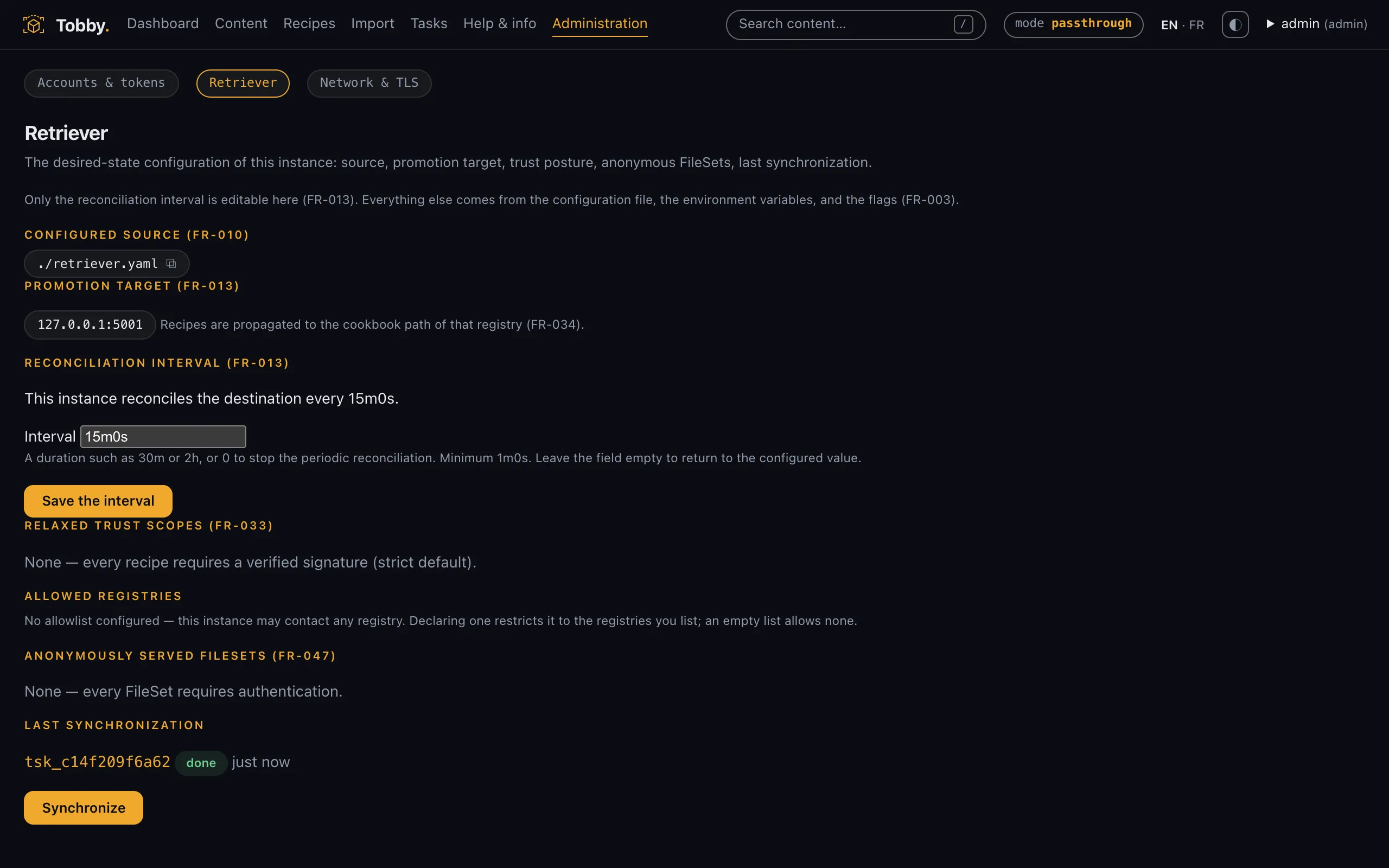
The configured source is reported as configured on the Retriever
administration screen (/admin/retriever, admin role) and its API
mirror GET /api/v1/retriever — alongside the declared relaxed trust
scopes and the effective synchronization interval. The interval override
lives on the same screen (PUT /api/v1/retriever/interval, and DELETE
to return to the configured value); it persists in the state directory,
survives restarts, wins over sync.interval, and is audited as a
sensitive configuration change (FR-094).
At each cycle the instance resolves every listed recipe from the cookbook, verifies its signature against the configured trust roots (FR-033), and reconciles. Version constraints are resolved at each pass; if no published version satisfies a constraint, that entry fails and says so — the other entries carry on. One unpublishable recipe never blocks the zone.
The cascade: connected → restricted → more restricted
Section titled “The cascade: connected → restricted → more restricted”Real topologies chain zones. The upstream zone promotes into its
registry; the downstream zone’s Tobby fetches from that registry
even though the recipes — immutable, signed, bit-exact — keep naming the
origin hosts (docker.io/...). The bridge is source substitution
(FR-036):
# Downstream instanceregistries:  substitutions:    docker.io: registry.upstream.example/docker.io    ghcr.io: registry.upstream.example/ghcr.io
retriever:  source: oci://registry.upstream.example/cookbook/retriever:v1
Substitution changes only the network endpoint contacted — never the
computed destination path (FR-035). That invariance is what makes the
cascade compose: docker.io/bitnami/wordpress relocates to
<registry>/docker.io/bitnami/wordpress in every zone, however many
hops it crossed, and never degenerates into
reg.zone2/reg.zone1/docker.io/.... Each zone’s registry holds the same
relocated paths under its own host, and each zone’s cookbook — populated
by recipe propagation (FR-034) — is what the next zone’s Retriever
points at. The rule and its rationale are
ADR-0013; the normative grammar (host
canonicalization, port encoding, substitution semantics) is
RECIPE-SPEC §11.5.
Two policies deliberately read different references:
- The registry allowlist (FR-030) and credential lookup apply to the effective host actually contacted — the substitute. That is where the bytes come from, so that is what network policy must name.
- Trust-root scopes (FR-033) match the nominal
refwritten in the recipe. Signed provenance does not change because content was fetched from a closer copy.
Logs record the nominal→effective mapping on every substituted fetch, so an audit can always answer both “what was this content” and “where did these bytes come from”.
Credentials between instances
Section titled “Credentials between instances”A downstream instance authenticates to its upstream like any registry client. Create a dedicated account (or token) on the upstream instance — see authentication and RBAC — with read as its only need, and hand it to the downstream instance through its credentials file (FR-004):
registries: credentialsFile: /etc/tobby-credentials/config.jsonThe file is a standard dockerconfigjson payload; entries are looked up
by the effective host, so the entry names the upstream registry —
registry.upstream.example — not docker.io. It must live outside the
store (secrets never travel on transportable media), and on Kubernetes
it is a mounted Secret the chart wires for you. Write-scoped credentials
follow the same path: pushing to the zone’s destination registry uses
the same credentials file, keyed by the destination host.
The destination side of the same instance is its own configuration
section — destination.registry, plus destination.basePath and
destination.cookbook — deliberately separate from substitutions: one
answers “where do I read from”, the other “where do I promote to”, and
applying a read-side rewrite to a write would publish to a registry
nobody named.
Next: your clusters and hosts consume what landed — connect your clients.